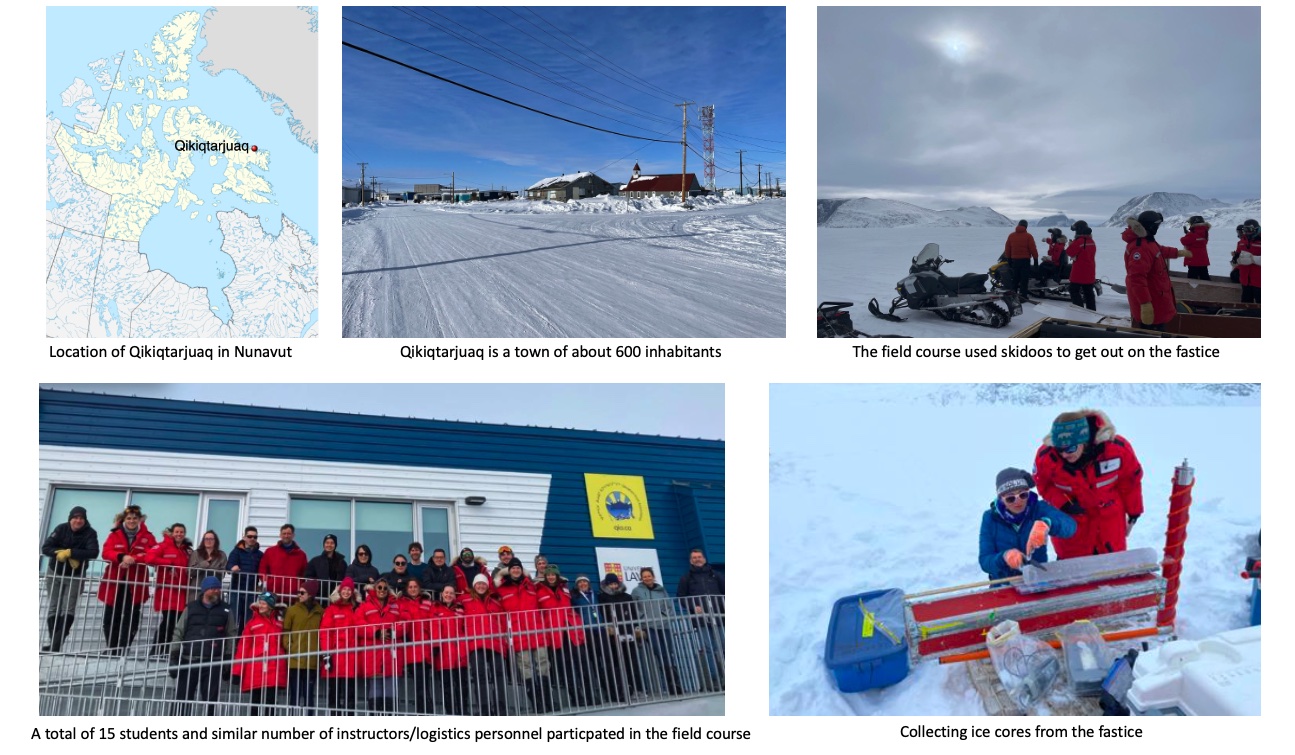
The field course was organised by the Sentinel North program of Université Laval (Quebec City, Canada) in collaboration with the UAK project. The course was held at the Qikiqtarjuaq Research Station (Nunavut, Canada) (67° 33′ N, 64° 01′ W), which was opened just before the course started. The course included different disciplines connected to sea ice, in particular Arctic marine biology and ecology, marine physics, biochemistry, optics-photonics and remote sensing. The station is located in an area where the continental shelf is very narrow, which means that the ocean rapidly reaches a depth of 400 metres. This particular geographic location makes it possible to study conditions that are typical of the deep sea while staying near the coast. It is a prime observation site for monitoring changes in populations of fish, small marine organisms, microalgae and microbes in response to environmental changes. The long-term objective is to make the Qikiqtarjuaq station a leading hub for marine research in the Arctic, where all levels of the food chain and how they change over time can be studied. The participants also met with community members of Qikiqtarjuaq, and learned about their culture and living conditions.