
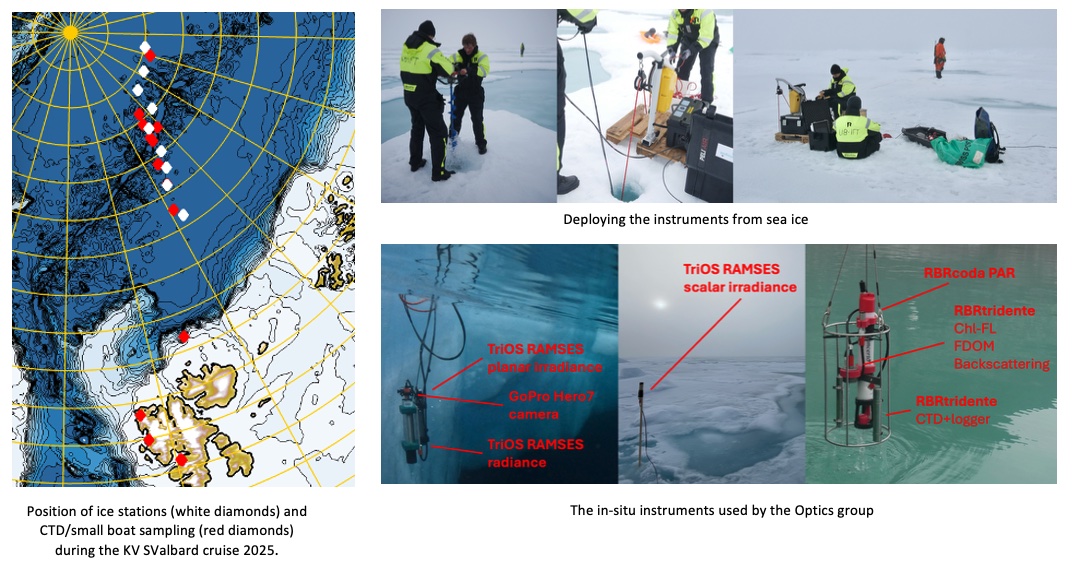
As part of their UAK activities, the Optics group at Institute for Physics and Technology, University of Bergen (UiB-IFT) participated in the KV Svalbard cruise in July-August 2025. The participants were Håkon Sandven (leader) and the MSc students Karl Arvid Fritze and Torbjørn Wigum Arbo. During the cruise optical data were collected with different instruments as part of the students’ research projects. One student investigated how light is transmitted through sea ice using radiative measurements at various depths. Light provides energy for photosynthesis, and its penetration through ice-covered waters is important for Arctic marine ecosystems, from phytoplankton to fish. The second student analyzed water samples from various depths to characterize the origin and properties of different water masses. These measurements can help track the freshwater composition in the central Arctic and estimate how the various water masses affect the underwater light environment.
With a declining and thinning sea ice cover, the amount and spectral composition (i.e. colour) of light underwater is rapidly changing in the Arctic Ocean which is affecting the marine ecosystem. It is very challenging to observe and model these changes due to logistical difficulties and the complex and interwoven factors controlling the Arctic light environment. We conducted measurements to characterise the effect of sea ice on underwater light, but also properties of the water column that affect the attenuation of light through the water column. The measurements may also help improve our capabilities of observing biochemical changes in the Arctic Ocean by testing sensors used on autonomous platforms, e.g. BGC-Argo buoys, which have so far been sparsely used in ice-covered waters.
During the cruise several acoustic experiments were conducted by personnel from NERSC and University of Rhode Island (URI). As part of UAK the team from URI (Savannah Passaretti-Fina and Luis Pomales Velázquez) tested acoustic transmission from the HiAOOS mooring network to a buoyancy float. These tests were done to prepare for geo-positioning of floats and gliders using low-frequency sources deployed in HiAOOS. During the cruise acoustic receptions of the signals transmitted by the HiAOOS mooring network were recorded, the data were filtering and down-sampling onboard, down-sampled and compressed audio data were transmitted via satellite back to shore, and in situ profiles of temperature, salinity and pressure were collected for the calculation of sound-speed. The tests are an important step towards deployment of Argo floats and gliders using acoustic geo-positioning for observations of ice covered oceans.
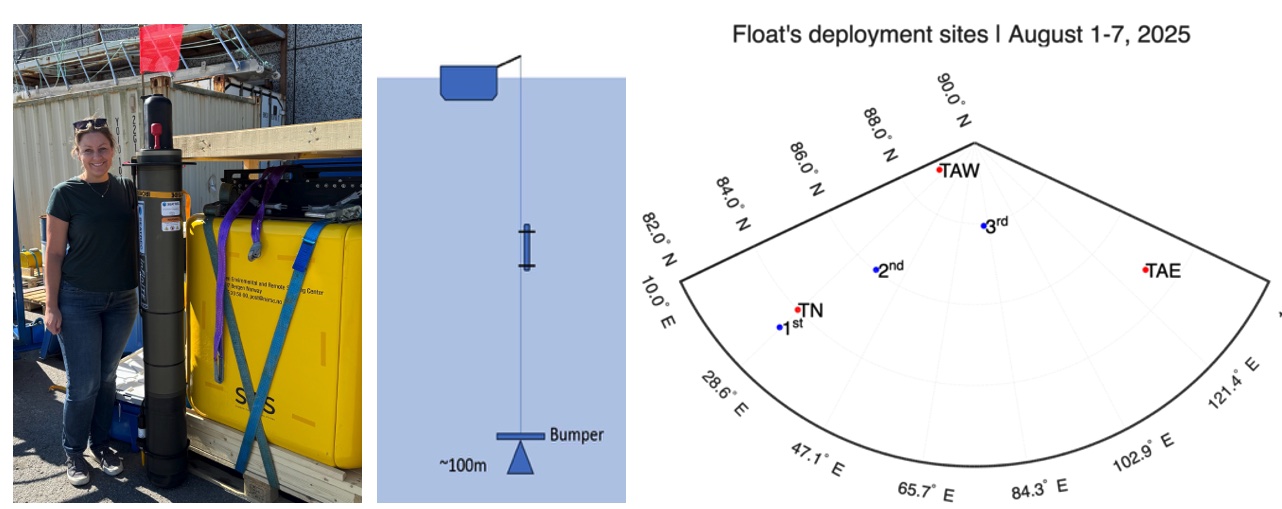
Left: Photo of the Seatrec float and Lora van Uffelen from University of Rhode Island, Center: tethering of the float, Right: map of the deployments of the float (blue dots) and the location of the source moorings (red dots).